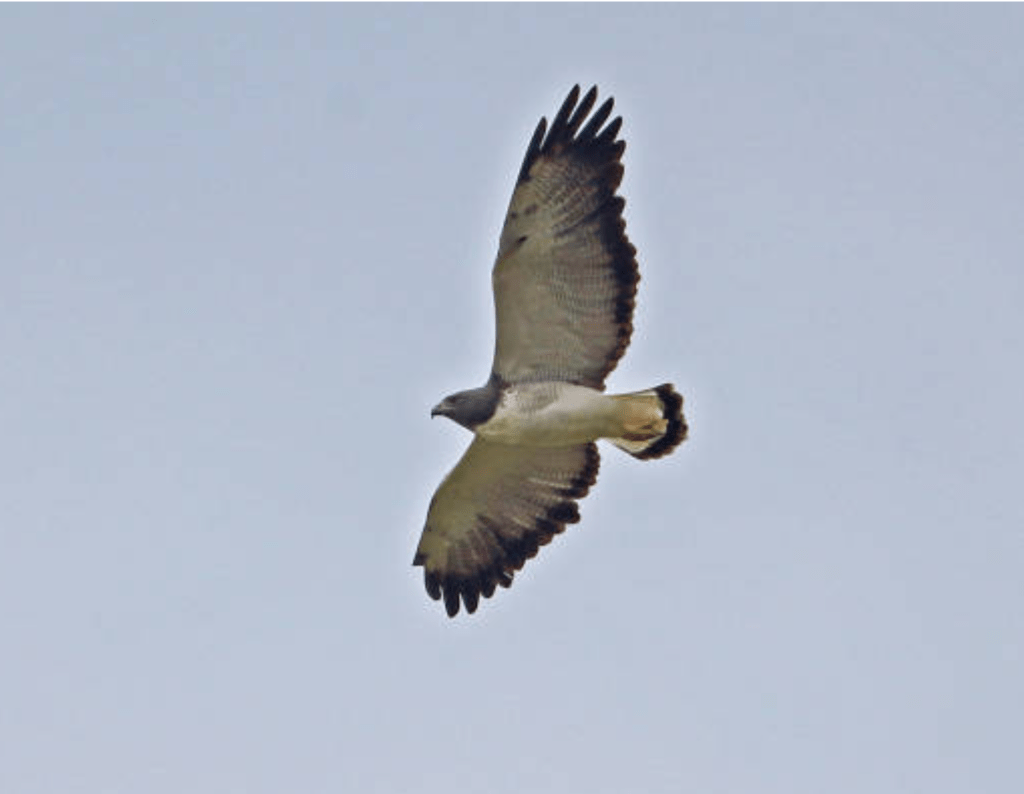
The White‑tailed Hawk is one of those unmistakable South Texas residents—broad‑winged, long‑legged, and built for the open country. It’s a species we expect to see year‑round across the coastal prairies, ranchlands, and wide agricultural fields of the Rio Grande Valley. They’re not migratory in the traditional sense, and yet, this winter and early spring in the Mid Valley, their movements have felt anything but static.
Over the past several weeks, I’ve noticed more White‑tailed Hawks than usual drifting over areas where I rarely encountered them before. Not in the deep urban core, but close enough to town to raise an eyebrow. For a bird so closely tied to open grasslands and savannas, these shifts stand out.
Why Are They Moving?
Several factors may be pushing these hawks to roam more widely than we’re used to seeing:
Breeding season pressures
As the dry season approaches, White‑tailed Hawks begin searching for nesting territories. Competition can push younger or subordinate birds into new areas as they look for space to establish themselves.
Territorial reshuffling
Even resident raptors adjust their ranges when dominant birds shift, disperse, or fail to return. A single vacancy can ripple across a landscape.
Extended drought
South Texas has endured long, punishing dry spells. When prey availability drops, raptors expand their search radius. Small mammals, reptiles, and ground‑dwelling birds—the hawk’s primary diet—are all affected by drought cycles.
Changes in food availability
Historically, winter sugarcane burns created a temporary but reliable buffet. As the flames moved through the fields, anything that didn’t escape—rats, snakes, insects—became easy prey. White‑tailed Hawks dominated those scenes.
With the closure of the last sugar mill in Texas, those fields are gone. So is that seasonal feeding opportunity. Whether this has affected local population numbers is hard to say without data, but from my own time in the field, the abundance we once saw during burn season simply isn’t there anymore.
A Hawk Built for the Open Country
White‑tailed Hawks are specialists of wide horizons. Their preferred habitats include:
Coastal prairies
Open grasslands
Savannas
Agricultural fields and ranchlands
They’re not typically associated with urban environments, which is why seeing them closer to developed areas—even if only the fringes—feels noteworthy.
Their hunting style is unmistakable: long, soaring circuits over open ground, riding thermals with minimal effort. Their eyesight is exceptional, allowing them to spot movement far below. Small mammals make up most of their diet, though they also feed on birds, reptiles and large insects. They’re opportunistic when conditions allow, stealing prey from the smaller Swainson’s Hawk.
Breeding Behavior
Breeding usually aligns with the dry season. Pairs build nests in trees or large shrubs, often choosing elevated sites with clear views of the surrounding landscape. Their territories can be expansive, and competition for prime nesting spots can be fierce—another reason birds may be shifting around the Valley.
A Changing Landscape
The Valley is not the same landscape it was twenty or even ten years ago. Agriculture has changed. Urban edges have expanded. The sugarcane burns that once defined winter fields are now a memory. All of this shapes how wildlife moves, adapts, and persists.
Whether White‑tailed Hawk numbers have declined locally is something only long‑term data can confirm. My own impression is simply that the patterns have changed. The birds are still here—still soaring, still hunting—but they’re showing up in places that make you pause and take a second look.
And that’s part of what makes birding in South Texas so compelling. Even with a resident species, there’s always something new to notice, something shifting beneath the surface of what we think we know.
 Rio Delta Birding Tours
Leave a comment